

Over 60% of CRM failures come down to people and process problems. Less than 10% stem from actual software defects. That single data point, documented across Vantage Point’s analysis of 400+ implementations, explains why switching platforms rarely fixes anything. The CRM was never the problem.
When an implementation fails at a small consulting firm, the symptoms look identical every time. Sales reps keep their real pipeline in a personal spreadsheet. Operations pulls data into a separate reporting tool before leadership meetings. Project managers track client work in a third system nobody connected. The CRM sits there, technically live, functionally abandoned. Teams don’t reject it out of stubbornness. They reject it because it was built on top of a process that doesn’t match how they actually work.
The failure happens upstream, before configuration begins
Most implementations start with a platform decision and a feature checklist. Someone maps the firm’s sales stages onto the software’s default pipeline. Fields get added. Automations get built. Dashboards get designed. What rarely gets documented is the actual workflow the team runs today, including the informal handoffs, the unwritten exceptions, and the decisions that happen in Slack threads and hallway conversations.
Once the system goes live, those undocumented realities collide with the configured process. A lead qualification rule fires too early. A required field blocks a deal that has real context the software doesn’t capture. A handoff between sales and delivery fails because the trigger was designed around an assumption that doesn’t hold. Within a quarter, the team has built workarounds. Within two, the CRM is a reporting shell.
The symptom is never the cause
Leaders tend to diagnose CRM failure by what they see in the daily work. The real problem almost always sits one level upstream, in a process decision that was never made or never documented. The pattern holds across most small consulting firms:
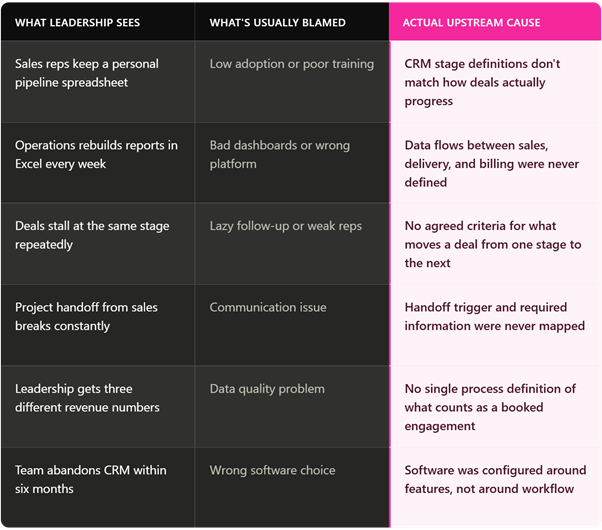
Pattern observed across small B2B consulting firms (5-50 employees) running Zoho, Salesforce, HubSpot, or Pipedrive. The platform changes. The root cause rarely does.
The middle column is where most firms spend their energy and money. The right column is where the actual fix lives.
Sales bypasses the system when it slows them down
The fastest way to lose a sales team is to turn the CRM into a data entry tax. When the system asks for information the rep hasn’t gathered yet, forces a stage change before the deal is actually ready, or adds five minutes to a task that used to take thirty seconds, reps quietly stop using it. HubSpot’s 2024 Sales Trends Report found that sales reps spend only two hours a day actually selling, with about an hour lost to administrative tasks, and poorly configured CRMs are a leading contributor.
The fix isn’t better training. It’s better process design. A sales rep will use a system that mirrors their real workflow. They will abandon one that was designed around how leadership wants to report on them.
Operations runs parallel reports when the data can’t be trusted
When a CRM’s data is incomplete, inconsistent, or contradicted by other systems, operations leaders stop using it for decisions. They pull the raw data into a spreadsheet, clean it, cross-reference it against project tracking and invoicing, and build their own version of the truth. That parallel reporting layer is a signal, not a habit. It means the CRM isn’t connected to the processes it was supposed to support.
Consulting firms feel this most acutely. Sales data lives in one place. Project delivery lives in another. Invoicing lives in a third. When those systems don’t share a common process definition of what a client engagement actually is, leadership gets three versions of reality. The fix is integration at the process layer, not just the software layer.
Process mapping before platform configuration is the fix
The implementations that succeed follow a sequence most vendors skip. Workflows get documented first. Handoffs get named. Exceptions get written down. Only then does the software get configured to support the process, not replace it.
Zoho One gives implementers serious tools for this once the process work is done. Zoho CRM’s Blueprint module lets you encode multi-stage sales processes with required actions at each transition, so the system enforces the workflow without making reps guess what comes next. Zoho Flow connects that process across marketing, delivery, and billing so the same engagement record carries through every system. None of that works if the process underneath is wrong.
The implementation you bought is not the one you needed
Firms that succeed with their second CRM didn’t switch platforms. They rebuilt the process first, then reconfigured the system they already had. The ones that keep failing are the ones still treating implementation as a software problem. Process comes first. Platform comes second. Get that order wrong and no tool will save the project.
Book your implementation strategy with Peter